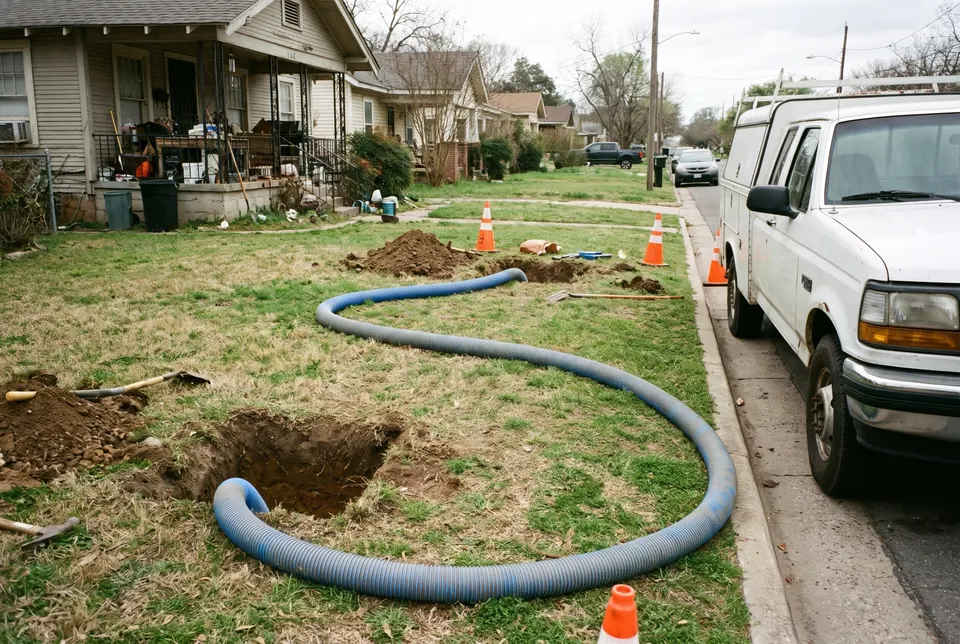
What is trenchless sewer repair?
Trenchless sewer repair fixes a buried sewer lateral without digging a trench along its whole length. The International Pipe Bursting Association, a division of the trade group NASSCO, says the two main trenchless methods for private laterals are cured-in-place pipe (CIPP) lining and pipe bursting, and that both should be considered before traditional open-cut construction (Underground Construction).
The association describes CIPP as rehabilitation that relines the existing pipe, often with no digging, and pipe bursting as replacement that installs a new pipe of the same or larger inside diameter without opening the whole trench. Some excavation is still needed for bursting.
How does pipe lining work?
Pipe lining installs a resin-soaked liner inside the old pipe, then cures it so it hardens into a new pipe within the old one. NASSCO's lateral lining guideline says the liner can be put in by inversion or pull-in through a cleanout, an access pit or the main, and that the installer cleans the pipe and records camera video before lining and gives the owner a copy (NASSCO).
Under that guideline, the liner follows the ASTM F1216 standard, is designed for 50 years or longer, and any active connections are reopened afterward. The guideline is a model specification for agencies that buy lining work, not a promise from any plumber, so ask what your plumber will put in writing. The same guideline sets a one-year warranty on materials and installation, which is a useful baseline to compare against.
How does pipe bursting work?
Pipe bursting breaks the old pipe outward while pulling a new one into its place. The IPBA says a crew digs a pit at each end, strings a chain, cable or rod through the old pipe, and pulls a bursting head, about 20 percent larger than the new pipe's outside diameter, through it while the new pipe follows. Typical lateral units pull with 30 to 40 or more tons of static force (Underground Construction).
The new pipe is usually HDPE, a fused plastic, or PVC. Most private residential laterals are 4 to 6 inches inside, and bursting can increase the diameter, which adds capacity. The IPBA also says a pipe that is structurally deficient, partly collapsed, heavy with roots or severely offset can be replaced by bursting with little prep, unlike lining. Utilities that cross the lateral must be located first, which in California starts with a call to 811 (USA North 811).
When can trenchless repair not be used?
Lining cannot fix a pipe that has lost its shape or alignment. Pinellas County, Florida, approves lining of a whole private lateral only if it has no sags, deflections or offset joints, and requires a pre-approval camera video from a licensed plumbing contractor (Pinellas County). NASSCO's guideline says that if a pre-lining camera run finds an obstruction, misalignment, broken or collapsed section or sag, the owner may have to repair it by open cut or another method before the line is lined.
Those are examples from other agencies, not Sacramento rules, but the physics is the same. A liner takes the shape of the pipe it sits in. If the camera shows a collapsed section or a belly that holds water, expect a spot excavation, a bursting job or a full replacement instead.
Bursting has its own limits. It needs pits for the pulling machine and the new pipe, and the crew has to work around other buried lines. A pit in a driveway, under a tree or near a utility crossing can change the price or the method.
- Sags or bellies that hold water: lining will not fix them; bursting or open cut can.
- Offset joints or a collapsed section: lining is limited; bursting or open cut is usually next.
- Crossing utilities or limited pit space: bursting may need a different layout.
- No cleanout or poor access: ask how the liner or new pipe will be installed and how connections are reopened.
Who owns which part of the sewer line?
In SacSewer's area, you own the upper lateral from the house to the SacSewer cleanout, and SacSewer owns the lower lateral from that cleanout to the main (SacSewer). Its ordinance says the owner is solely responsible for clearing, inspecting, maintaining and repairing the upper lateral, and that where there is no SacSewer cleanout the dividing point is the edge of the easement or public right-of-way (SacSewer Ordinance).
Other agencies, including the City of Sacramento, Roseville, Folsom and Davis, draw the line elsewhere. Call your agency before you hire anyone for work near the street, because a trenchless job that crosses the property line may be the agency's to do or to approve.
Does trenchless sewer repair need a permit in Sacramento?
Yes, repair and replacement of a sewer lateral is permitted work. The City of Sacramento lists sewer repair and replacement among its minor residential plumbing permits (City of Sacramento), and Sacramento County says residential sewer line repair or replacement permits can be issued automatically online (Sacramento County). The contractor usually pulls the permit; the CSLB says your contract should state who does.
SacSewer's ordinance adds that local jurisdictions inspect the upper lateral and building sewer, and that replacing more than 10 feet of the upper lateral means the owner must build a SacSewer cleanout. None of the sources above says whether lining or bursting counts as replacement under that cleanout rule, so ask your permit office and SacSewer before you sign. Work in a street or sidewalk may need its own permit as well.
How much does trenchless sewer repair cost?
National guides put lining at about $90 to $250 per foot (HomeGuide, 2026) or $80 to $250 per foot (Angi, 2026), and pipe bursting at $60 to $200 per foot (HomeGuide, 2026) or $150 to $190 per foot with lining (Angi, 2026). Angi notes residential sewer lines average 50 to 75 feet (Angi).
As a rough check, 50 feet at $90 to $250 per foot is $4,500 to $12,500. These are national figures, not Sacramento quotes. HomeGuide lists open-cut replacement at $50 to $250 per foot, so trenchless is not always cheaper per foot; the savings come from less digging and less restoration of driveways, landscaping and concrete (HomeGuide).
Get written quotes for lining, bursting and open cut if the pipe allows more than one, and ask what the price includes: cleaning, camera work, pits, restoration, the permit and reopening connections.
How do I check a trenchless contractor's license?
Look up the license on the CSLB license check. The CSLB says A General Engineering, C-36 Plumbing, C-42 Sanitation System and C-34 Pipeline contractors may install or repair building sewers (CSLB). The C-42 classification covers sewage and drain structures and several pipe types (CSLB).
Some plumbers subcontract the lining or bursting. Ask who will do the work, and look up that company's license too. A written contract is required for jobs over $500 and should name the contractor, their license number and who pulls the permit (CSLB).
What should I ask before agreeing to trenchless repair?
Camera findings and a written scope should drive the decision.
- Can I see the camera video that shows why trenchless is possible for my pipe?
- Is it lining or bursting, and what is the new pipe or liner made of?
- Which standard does the liner meet? NASSCO's guideline cites ASTM F1216.
- Will you clean and camera the line after the work and give me the video?
- How will the connections and cleanouts be handled, and where will the pits go?
- Who pulls the permit, who requests the inspection, and what warranty is in writing?
| What to compare | Pipe lining (CIPP) | Pipe bursting | Open-cut trench |
|---|---|---|---|
| What it does | Adds a new resin liner inside the old pipe | Breaks the old pipe and pulls in a new one | Digs up the old pipe and replaces it |
| Digging | Often none; sometimes an access pit | Entry and exit pits | Full trench along the line |
| Pipe condition | No sags, deflections or offset joints (Pinellas County) | Can handle partly collapsed, rooted or offset pipe (IPBA) | Any, including collapsed |
| Pipe size | Same or slightly smaller inside | Same or larger inside (IPBA) | Any |
| National cost 2026 | $80-$250 per foot (HomeGuide, Angi) | $60-$200 per foot (HomeGuide); $150-$190 per foot (Angi) | $50-$250 per foot for replacement (HomeGuide) |
Need a drain cleaning plumber in the Sacramento area?
Call to talk to a local drain cleaning plumber, describe the job and get a quote before any work starts. The call is free.
Frequently asked questions
Is pipe lining or pipe bursting better for my sewer line?
Does trenchless repair mean no digging at all?
How long does a pipe liner last?
Is trenchless sewer repair cheaper than digging?
Can trenchless repair fix a collapsed sewer pipe?
Sources
- Pipe Bursting For Replacement Of Sanitary Sewer Laterals (International Pipe Bursting Association, a division of NASSCO) — Underground Construction
- Cured-in-Place Pipe (CIPP) Lateral Pipe Lining Performance Specification Guideline — NASSCO
- Accepted Private Sewer Lateral Lining — Pinellas County, Florida
- Building Official Information Guide (license classes that may install or repair building sewers) — Contractors State License Board (CSLB)
- C-42 Sanitation System Contractor classification — Contractors State License Board (CSLB)
- Check a License or HIS Registration — Contractors State License Board (CSLB)
- What should I look for in a contract and binding agreements? — Contractors State License Board (CSLB)
- Minor Permits (includes sewer repair and replacement) — City of Sacramento Community Development
- Building Permits and Inspection: Frequently Asked Questions — Sacramento County Community Development
- SacSewer Ordinance (adopted 2026), Part 3 Collection System: maintenance responsibilities and backwater valves — SacSewer (Sacramento Area Sewer District)
- Customer vs SacSewer Responsibility — SacSewer (Sacramento Area Sewer District)
- Every Dig. Every Time. (call 811 before digging) — USA North 811
- How Much Does Sewer Line Replacement Cost? (2026) — HomeGuide
- How Much Does Trenchless Sewer Line Piping Cost? [2026 Data] — Angi